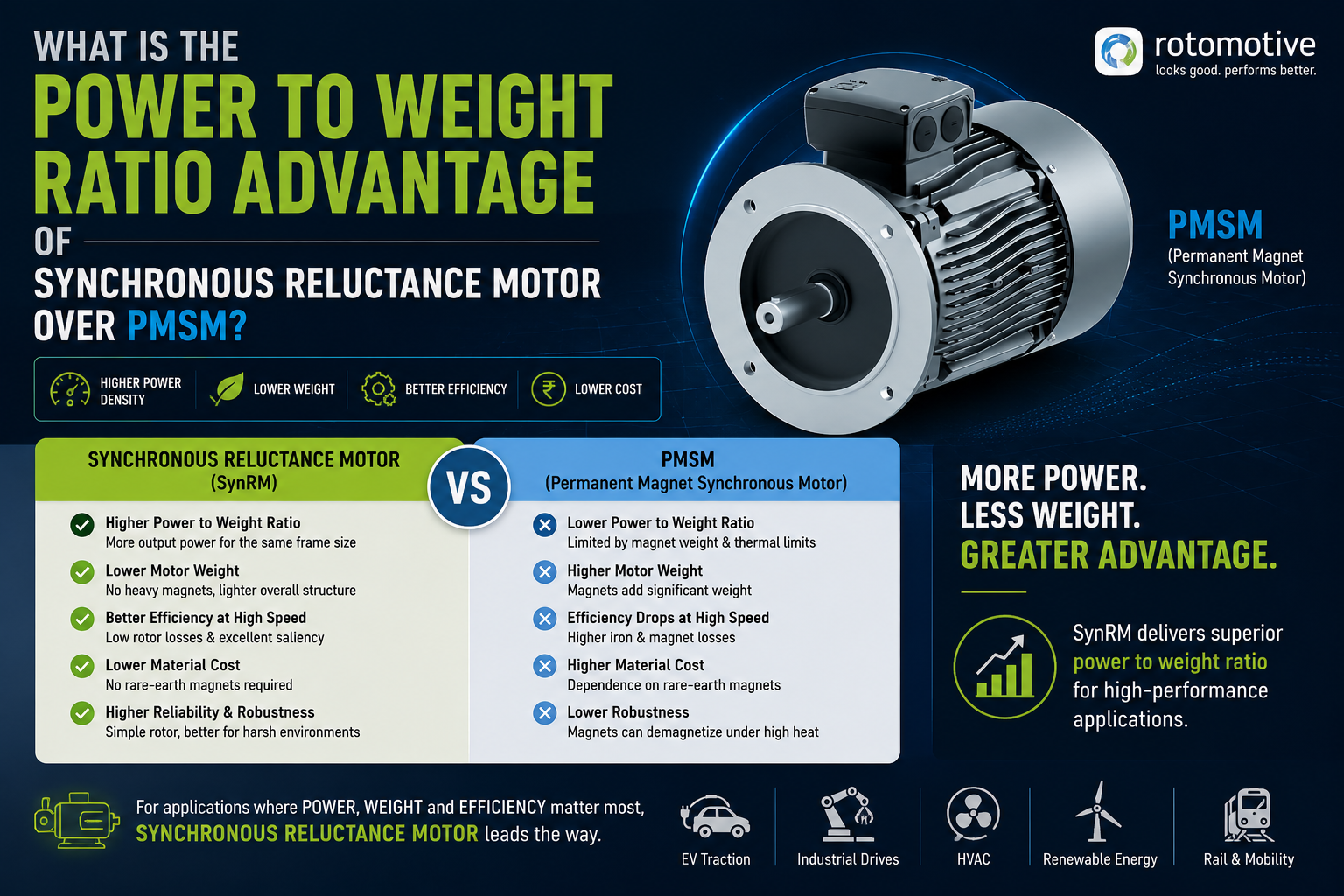
The power-to-weight ratio (P/W) advantage of a Synchronous Reluctance Motor (SynRM) over a Permanent Magnet Synchronous Motor (PMSM) is generally:
PMSM has higher power-to-weight ratio than SynRM
Not the other way around.
Let’s break it down technically and practically.
⚙️ 1. Why PMSM Typically Has Higher Power-to-Weight Ratio
🔹 PMSM
- Uses permanent magnets (NdFeB etc.)
- High air-gap flux density
- High torque density
- Compact rotor
- Higher efficiency at same frame size
🔹 SynRM
- No magnets
- Produces torque using reluctance torque only
- Lower air-gap flux
- Needs larger frame or more copper for same torque
📊 Typical Comparison (Industrial Grade Motors)
| Parameter | PMSM | SynRM |
| Power Density | 3–6 kW/kg | 2–4 kW/kg |
| Torque Density | Higher | Lower |
| Weight for Same Power | Lower | 10–25% higher |
| Efficiency | Slightly Higher | Slightly Lower (except optimized designs) |
🔢 Realistic Power-to-Weight Difference
For the same output power:
- PMSM is typically 15–30% lighter
- Or SynRM needs 15–30% more weight to produce same power
In high-performance EV-grade motors:
- PMSM advantage can be even higher
⚡ But Here’s the Important Twist
If we compare Cost-to-Weight or Magnet-Free Advantage, SynRM becomes attractive:
Advantages of SynRM:
- No rare earth magnets
- No demagnetization risk
- Lower material cost
- Better thermal robustness
- Suitable for harsh environments
🚗 In EV Applications
- Most EVs use PMSM because:
- Higher power density
- Compact packaging
- Better torque response
- SynRM is gaining traction in:
- Industrial drives
- Pumps, compressors
- Cost-sensitive applications
- Some magnet-assisted SynRM (M-SynRM) designs
🔬 What About Magnet-Assisted SynRM?
Magnet-assisted SynRM (PMa-SynRM):
- Nearly matches PMSM power density
- Reduces magnet volume by 40–60%
- Good compromise solution
Many modern EV designs are moving toward this hybrid structure.
📌 Final Answer
There is no power-to-weight advantage of pure SynRM over PMSM.
Instead:
- PMSM typically has 15–30% better power-to-weight ratio
- SynRM sacrifices density for cost & magnet independenc